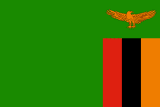
Zambia
Zambia
Population
21,913,874 (2025)
Average Monthly Net Salary (USD)
280
Average Mortgage Rate
23.50%
Annual GDP (USD)
28,879,806,220 (2025)
National Debt (USD)
21,340,000,000 (2025)
Unemployment Rate
5.92% (2025)
Armed Forces (active & reserve)
15,100
Military Expenditure (% GDP)
1.33% (2024)
Fertility Rate
4.04 (2024)
Life Expectancy at birth
66.5 years (2024)
Population Growth
2.77% (2025)
Net Migration
6,562 (2025)
Notable Facts
Zambia is a landlocked sovereign state situated on a high plateau in south-central Africa, bordered by eight nations: the Democratic Republic of the Congo, Tanzania, Malawi, Mozambique, Zimbabwe, Botswana, Namibia, and Angola. The country’s geography is dominated by a central plateau that ranges between 1,000 and 1,600 meters above sea level, deeply dissected by the Zambezi River and its tributaries, the Kafue and Luangwa. This elevated positioning results in a more temperate environment than its tropical latitude would suggest. The nation serves as a critical hydrological hub for Southern Africa, containing massive water bodies like Lake Bangweulu and parts of Lake Tanganyika and Lake Kariba, which influence regional navigation and energy production.
The Zambian economy is fundamentally anchored in the extractive industries, specifically the mining of copper and cobalt. As one of the world’s leading copper producers, the country’s fiscal health is traditionally tied to global commodity price cycles. The Copperbelt Province, located in the north-central region, remains the industrial heartland, hosting massive underground and open-cast operations. Beyond copper, Zambia possesses significant deposits of gold, nickel, and manganese, as well as high-quality emeralds. In recent years, the government has sought to diversify the economic base by encouraging large-scale commercial agriculture, leveraging the country's vast arable land and water resources to produce maize, tobacco, sugar, and cotton for regional export.
The political system of Zambia is a presidential representative democratic republic, where the President serves as both the head of state and head of government under a multi-party framework. Since gaining independence from British colonial rule in 1964, the country has maintained a relatively high degree of political stability compared to its neighbors. The constitution provides for a unicameral National Assembly consisting of 167 members, of whom 156 are directly elected by universal adult suffrage. The legal system is a dualistic model, blending English common law - a legacy of the protectorate era - with African customary law, which is often applied in local courts to handle matters of inheritance, marriage, and traditional land disputes.