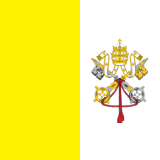
Vatican City
Vatican City
Population
952 (2026)
Average Monthly Net Salary (USD)
3,450
Average Mortgage Rate
3.85%
Annual GDP (USD)
N/A
National Debt (USD)
N/A
Unemployment Rate
N/A
Armed Forces (active & reserve)
135
Military Expenditure (% GDP)
N/A
Fertility Rate
N/A
Life Expectancy at birth
N/A
Population Growth
N/A
Net Migration
N/A
Notable Facts
The State of the Vatican City is the smallest independent nation-state in the world, both by area and by population. It is an enclaved sovereign city-state situated entirely within the city of Rome, Italy. Established in its current form by the Lateran Treaty of 1929, it serves as the spiritual and administrative center of the Roman Catholic Church. The territory is roughly 0.44 square kilometers, consisting of a small hill and the flat land surrounding St. Peter’s Basilica. Its boundaries are mostly defined by high stone walls that were originally built to protect the Pope from external threats. The city-state is a rare example of a non-hereditary elective monarchy, where the monarch is the Bishop of Rome.
The governance of the Vatican is unique because it functions as an absolute monarchy. The Pope holds supreme legislative, executive, and judicial power over the state. However, for practical administration, he delegates these powers. The legislative branch is managed by the Pontifical Commission for Vatican City State, composed of cardinals appointed by the Pope for five-year terms. Executive power is exercised by the President of the Commission, who also serves as the President of the Governorate. This administrative body oversees the daily operations of the city, including the police force, the post office, and the various technical services required to maintain the complex infrastructure of the historic enclave.
The citizenship of the Vatican is not based on birth or bloodline but is granted jus officii, meaning it is tied to one's office or employment within the Holy See. There are approximately 450 to 600 citizens at any given time, including the Pope, cardinals residing in Rome, and members of the Swiss Guard. Most citizens actually live outside the walls in Rome or abroad as diplomats. Vatican citizenship is usually temporary; when an individual ceases to work for the Holy See, their citizenship is revoked. If they do not possess any other nationality at that point, they are granted Italian citizenship by default under the terms of the Lateran Treaty to prevent statelessness.