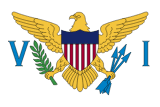
US Virgin Islands
US Virgin Islands
Population
103,792 (2025)
Average Monthly Net Salary (USD)
3,165
Average Mortgage Rate
6.90%
Annual GDP (USD)
4,672,000,000 (2022)
National Debt (USD)
3,400,000,000 (2022)
Unemployment Rate
11.44% (2025)
Armed Forces (active & reserve)
N/A
Military Expenditure (% GDP)
N/A
Fertility Rate
1.97 (2024)
Life Expectancy at birth
80.8 years (2024)
Population Growth
-0.56% (2025)
Net Migration
-357 (2025)
Notable Facts
The United States Virgin Islands (USVI) is an organized, unincorporated United States territory located in the Leeward Islands of the Lesser Antilles. The territory is composed of the primary islands of Saint Croix, Saint John, and Saint Thomas, along with Water Island and dozens of smaller surrounding cays. Geographically situated between the Atlantic Ocean and the Caribbean Sea, the islands were formed primarily through volcanic activity and are characterized by a rugged, hilly terrain. While the territory lacks a single centralized landmass, it functions under a unified administrative structure overseen by the U.S. Department of the Interior’s Office of Insular Affairs, with the territorial capital and largest population center located at Charlotte Amalie on the island of Saint Thomas.
The political status of the USVI is governed by the Revised Organic Act of 1954, which established the current framework of the territorial government. As an unincorporated territory, the U.S. Constitution applies only partially; notably, while residents are U.S. citizens by birth, they do not vote in U.S. presidential elections and are represented in the U.S. House of Representatives by a single delegate who has no voting power on the House floor. The local government is divided into three branches: a bicameral-style executive headed by a popularly elected Governor, a unicameral Legislature consisting of fifteen senators, and a judiciary. This autonomous local structure allows the territory to manage its own internal affairs, including taxation and local law enforcement, while remaining under federal sovereignty.
The historical trajectory of the islands is defined by a long period of Danish colonial rule, lasting from the late 17th century until 1917. Originally claimed by various European powers, the Danish West India Company eventually established permanent settlements, turning the islands into a major center for the trans-Atlantic slave trade and sugar production. During the 18th century, the Danish West Indies became one of the most profitable colonial enterprises in the Caribbean, fueled by the labor of enslaved Africans. The decline of the sugar industry following the 1848 abolition of slavery led to a long period of economic stagnation, eventually prompting Denmark to sell the islands to the United States for $25 million in gold during World War I to prevent German naval expansion in the region.