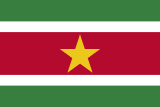
Suriname
Suriname
Population
639,850 (2025)
Average Monthly Net Salary (USD)
460
Average Mortgage Rate
14.00%
Annual GDP (USD)
4,523,657,797 (2025)
National Debt (USD)
3,310,000,000 (2025)
Unemployment Rate
7.83% (2025)
Armed Forces (active & reserve)
1,840
Military Expenditure (% GDP)
N/A
Fertility Rate
2.23 (2024)
Life Expectancy at birth
73.8 years (2024)
Population Growth
0.85% (2025)
Net Migration
-967 (2025)
Notable Facts
Suriname, officially known as the Republic of Suriname, is located on the northeastern Atlantic coast of South America. It is bordered by French Guiana to the east, Guyana to the west, and Brazil to the south. Geographically, the country is divided into two main regions: the northern, lowland coastal area, where the majority of the population resides and where most agricultural activity occurs, and the southern part, which consists of tropical rainforest and sparsely inhabited savanna stretching toward the Brazilian border. The country is part of the Guiana Shield, one of the oldest and most geologically stable regions on Earth, characterized by ancient crystalline rocks and dense primary forest that covers approximately 93% of the total land area.
The political system of Suriname is a representative democratic republic based on the 1987 Constitution. The executive branch is led by a President, who is elected by a two-thirds majority of the National Assembly for a five-year term. If a two-thirds majority cannot be reached, the President is elected by the United People's Assembly, a body consisting of national, regional, and local representatives. The President serves as both the head of state and head of government, presiding over a Cabinet of Ministers. The legislative branch is a unicameral National Assembly consisting of 51 members elected by popular vote under a proportional representation system. The administrative divisions of the country consist of ten districts, each headed by a district commissioner appointed by the President.
The legal system of Suriname is primarily based on the Dutch civil law tradition, reflecting its colonial history as a constituent part of the Kingdom of the Netherlands until 1975. The judiciary is headed by the High Court of Justice, which oversees the lower cantonal courts and serves as the final court of appeal for civil and criminal matters. Judges are appointed for life by the President in consultation with the High Court. Suriname is also a member of the Caribbean Court of Justice (CCJ), though it currently utilizes the CCJ primarily for its original jurisdiction regarding the interpretation of the Revised Treaty of Chaguaramas, rather than as its final appellate court for domestic legal disputes.