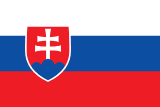
Slovakia
Slovakia
Population
5,413,813 (2025)
Average Monthly Net Salary (USD)
1,280
Average Mortgage Rate
4.45%
Annual GDP (USD)
154,530,066,507 (2025)
National Debt (USD)
86,410,000,000 (2025)
Unemployment Rate
5.36% (2025)
Armed Forces (active & reserve)
30,000
Military Expenditure (% GDP)
2.01% (2024)
Fertility Rate
1.46 (2024)
Life Expectancy at birth
78.4 years (2024)
Population Growth
-0.15% (2025)
Net Migration
-31,377 (2025)
Notable Facts
The Slovak Republic is a landlocked sovereign state situated in the geographical heart of Central Europe. It is bordered by Poland to the north, Ukraine to the east, Hungary to the south, Austria to the southwest, and the Czech Republic to the northwest. The nation’s physical geography is dominated by the Carpathian Mountains, specifically the Tatra range in the north, which features high-altitude peaks, glacial lakes, and deep valleys. The southern regions transition into the fertile Danubian Lowland, part of the Pannonian Basin, where the climate is significantly warmer and the terrain is characterized by expansive plains and the country’s primary agricultural zones.
Slovakia became an independent state on January 1, 1993, following the peaceful dissolution of Czechoslovakia, an event frequently referred to as the "Velvet Divorce." Prior to this, the Slovak people had been part of the Austro-Hungarian Empire for centuries until the formation of the first Czechoslovak Republic in 1918. Since achieving sovereignty, Slovakia has integrated rapidly into Western international structures, joining both the European Union and the North Atlantic Treaty Organization (NATO) in 2004. This transition marked a shift from a centrally planned economy to a modern, market-driven democracy, characterized by significant foreign investment and institutional reform.
The political system of Slovakia is a parliamentary republic. The President serves as the head of state and is elected by popular vote for a five-year term; while the role is largely ceremonial, the President possesses the power to veto legislation and appoint the Prime Minister. Executive power is vested in the Prime Minister, who leads the government and is typically the leader of the majority party in the National Council. The National Council of the Slovak Republic is a unicameral legislature consisting of 150 members elected through proportional representation. The judiciary is independent, with a Constitutional Court ensuring that all laws and executive actions align with the nation’s supreme legal framework.