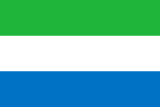
Sierra Leone
Sierra Leone
Population
8,819,794 (2025)
Average Monthly Net Salary (USD)
115
Average Mortgage Rate
22.00%
Annual GDP (USD)
7,464,157,904 (2025)
National Debt (USD)
2,140,000,000 (2025)
Unemployment Rate
3.15% (2025)
Armed Forces (active & reserve)
8,500
Military Expenditure (% GDP)
0.46% (2024)
Fertility Rate
3.70 (2024)
Life Expectancy at birth
62.0 years (2024)
Population Growth
2.04% (2025)
Net Migration
-11,309 (2025)
Notable Facts
The Republic of Sierra Leone is located on the southwest coast of West Africa, bordered by Guinea to the north and east, Liberia to the southeast, and the Atlantic Ocean to the west and southwest. The country’s geography is divided into four distinct physical regions: the coastal Guinean mangroves, the wooded hill country, an upland plateau, and the eastern mountains. Mount Bintumani, also known as Loma Mansa, is the highest point in the country, rising to 1,945 meters within the Loma Mountains. This varied topography supports a tropical climate with a significant rainy season, feeding a network of major rivers including the Rokel, the Moa, and the Sewa, which are essential for the nation's agricultural and mining activities.
Sierra Leone gained its independence from the United Kingdom on April 27, 1961, transitioning from a colonial protectorate to a sovereign constitutional monarchy before becoming a republic in 1971. The nation’s history is uniquely tied to the abolition of the slave trade; Freetown, the capital, was founded in 1787 by the "Black Poor" from London and later served as a haven for "Liberated Africans" intercepted by the British Royal Navy. This heritage led to the development of the Krio people, an ethnic group with a distinct language and culture that heavily influenced the country's administrative and educational foundations. Despite a period of civil conflict in the late 20th century, the country has maintained a stable multi-party democracy since 2002.
The political system is a unitary presidential republic, where the President serves as both the head of state and the head of government. The President is elected by popular vote for a maximum of two five-year terms. Legislative power is held by the Parliament of Sierra Leone, a unicameral body consisting of 149 members, of which 135 are directly elected and 14 are Paramount Chiefs representing the country’s administrative districts. The legal system is a blend of English Common Law and customary law based on local tribal traditions. This dual system allows the central government to maintain national legal standards while respecting the traditional leadership structures that remain influential in rural provinces.