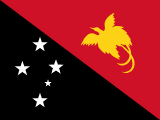
Papua New Guinea
Papua New Guinea
Population
10,762,817 (2025)
Average Monthly Net Salary (USD)
580
Average Mortgage Rate
8.75%
Annual GDP (USD)
32,498,658,654 (2025)
National Debt (USD)
16,420,000,000 (2025)
Unemployment Rate
2.57% (2025)
Armed Forces (active & reserve)
4,000
Military Expenditure (% GDP)
0.31% (2024)
Fertility Rate
3.07 (2024)
Life Expectancy at birth
66.3 years (2024)
Population Growth
1.75% (2025)
Net Migration
-284 (2025)
Notable Facts
The Independent State of Papua New Guinea (PNG) occupies the eastern half of the island of New Guinea, the second-largest island in the world, along with numerous offshore islands including New Britain, New Ireland, and Bougainville. It is situated in the southwestern Pacific Ocean, north of Australia and east of Indonesia. The country’s geography is among the most rugged on Earth, dominated by a massive central mountain range that runs the length of the mainland, reaching its highest point at Mount Wilhelm at 4,509 meters. This terrain, characterized by deep valleys and dense rainforests, has historically isolated communities, leading to the development of a society that is home to over 800 distinct languages - the highest linguistic diversity of any nation.
Politically, Papua New Guinea is a constitutional parliamentary democracy and a Commonwealth realm, with the British monarch as the ceremonial head of state, represented by a Governor-General. The head of government is the Prime Minister, who leads a unicameral National Parliament. Since gaining independence from Australia in 1975, the nation has navigated the challenges of unifying hundreds of traditional tribal societies into a single state. The administrative structure is divided into 22 province-level electorates, including the National Capital District around Port Moresby and the Autonomous Region of Bougainville. In early 2025, the government officially amended the constitution to adopt Christianity as the official state religion, reflecting the faith of the vast majority of the population.
The Kuk Early Agricultural Site, located in the Western Highlands, is a UNESCO World Heritage site that provides evidence of independent agricultural development dating back nearly 10,000 years. It is one of the few places in the world where humans independently transitioned from foraging to farming, focusing on crops like taro, yams, and bananas. Archaeological findings at Kuk include early drainage systems and mounds for plant cultivation, predating similar developments in many other parts of the world. This deep history of land management continues into the present, as approximately 80% of the population still relies on subsistence or semi-subsistence agriculture, living in rural villages that remain largely independent of the formal cash economy.