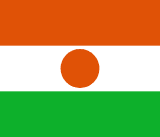
Niger
Niger
Population
27,917,831 (2025)
Average Monthly Net Salary (USD)
130
Average Mortgage Rate
10.50%
Annual GDP (USD)
21,646,191,388 (2025)
National Debt (USD)
8,110,000,000 (2025)
Unemployment Rate
0.39% (2025)
Armed Forces (active & reserve)
10,000
Military Expenditure (% GDP)
2.24% (2024)
Fertility Rate
5.93 (2024)
Life Expectancy at birth
61.4 years (2024)
Population Growth
3.22% (2025)
Net Migration
-7,704 (2025)
Notable Facts
Niger is a landlocked nation in West Africa, named after the Niger River which flows through its southwestern territory. It is the largest country in West Africa by land area, though over 80% of its terrain is covered by the Sahara Desert. The country serves as a geographical bridge between North Africa and Sub-Saharan Africa, bordered by Algeria and Libya to the north, Chad to the east, Nigeria and Benin to the south, and Mali and Burkina Faso to the west. Most of the population is concentrated in the far south and west, where the climate allows for more consistent agriculture. Geologically, the country is characterized by vast desert basins, the rugged Aïr Mountains in the north, and the fertile Niger River valley in the southwest.
The political history of Niger since its independence from France in 1960 has been marked by several periods of military rule and constitutional transitions. The country has functioned under several different republics, with the Seventh Republic being established by the 2010 Constitution. Niger is a semi-presidential republic where the President is the head of state, elected by popular vote, and the Prime Minister is the head of government, appointed by the President. The legislative branch is a unicameral National Assembly. Administratively, the country is divided into seven regions and one capital district, Niamey. Political life in Niger is often influenced by the need to balance the interests of various ethnic groups and the ongoing security challenges in the broader Sahel region.
Uranium is the primary engine of Niger's export economy, making the country one of the world's largest producers of the mineral. Mining operations are concentrated around the northern towns of Arlit and Akokan, situated on the edge of the Sahara Desert. Two major mines, Somair and Cominak, have historically provided a significant portion of the global supply for nuclear power, particularly for France. The uranium deposits were discovered in the late 1950s and have since dictated much of the country's industrial infrastructure. While uranium remains the dominant export, the volatility of global prices and the high costs of desert logistics present ongoing economic challenges. The government has recently sought to diversify its mineral sector by exploring gold, coal, and iron ore deposits.