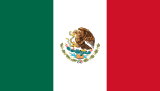
Mexico
Mexico
Population
131,946,900 (2025)
Average Monthly Net Salary (USD)
880
Average Mortgage Rate
11.20%
Annual GDP (USD)
1,832,641,364,776 (2025)
National Debt (USD)
974,250,000,000 (2025)
Unemployment Rate
2.67% (2025)
Armed Forces (active & reserve)
341,000
Military Expenditure (% GDP)
0.89% (2024)
Fertility Rate
1.89 (2024)
Life Expectancy at birth
75.3 years (2024)
Population Growth
0.83% (2025)
Net Migration
-108,037 (2025)
Notable Facts
The United Mexican States is a federal constitutional republic located in the southern portion of North America. It is bordered to the north by the United States of America, to the south and west by the Pacific Ocean, to the southeast by Guatemala, Belize, and the Caribbean Sea, and to the east by the Gulf of Mexico. The nation’s political structure is defined by the 1917 Constitution, which established a three-branch system of government consisting of the executive, legislative, and judicial arms. The President of Mexico serves as both the head of state and head of government, elected by popular vote for a single six-year term, a transition known locally as the sexenio. This political framework governs thirty-one sovereign states and the capital, Mexico City, which functions as a federal entity.
The demographic composition of the country is a complex result of the colonial era’s casta system, which merged indigenous populations with European, primarily Spanish, settlers. Today, the majority of the population identifies as Mestizo, representing a cultural and biological blend. Beyond this majority, the Mexican government recognizes sixty-eight distinct indigenous languages, which hold the status of national languages alongside Spanish. Among these, Nahuatl and Maya are the most widely spoken. The distribution of these populations is uneven, with a higher concentration of indigenous communities in the southern and southeastern regions, such as Oaxaca and Chiapas, while the northern states exhibit a more pronounced European ancestral influence due to different historical migration patterns.
Mexico City, the nation’s capital, is built upon the ruins of the Aztec city Tenochtitlan. Founded in 1325 in the Valley of Mexico, Tenochtitlan was an engineering marvel of the pre-Columbian world, constructed on an island in Lake Texcoco. The Aztecs utilized a system of chinampas, or floating gardens, to sustain a massive urban population. Following the Spanish conquest led by Hernán Cortés in 1521, the lake was gradually drained to allow for the expansion of a European-style city. This historical foundation has led to modern challenges, as the city sits on soft lakebed sediments, causing significant parts of the metropolitan area to subside or sink at measurable annual rates as groundwater is extracted for the massive population.