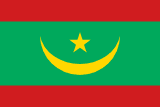
Mauritania
Mauritania
Population
5,315,065 (2025)
Average Monthly Net Salary (USD)
285
Average Mortgage Rate
12.00%
Annual GDP (USD)
11,679,910,946 (2025)
National Debt (USD)
2,980,000,000 (2025)
Unemployment Rate
10.32% (2025)
Armed Forces (active & reserve)
21,000
Military Expenditure (% GDP)
2.16% (2024)
Fertility Rate
4.63 (2024)
Life Expectancy at birth
68.7 years (2024)
Population Growth
2.78% (2025)
Net Migration
-5,044 (2025)
Notable Facts
The Islamic Republic of Mauritania is a sovereign state situated in Northwest Africa, forming a geographical and cultural bridge between the Maghreb region of North Africa and western sub-Saharan Africa. It is bordered by the Atlantic Ocean to the west, Western Sahara to the north and northwest, Algeria to the northeast, Mali to the east and southeast, and Senegal to the southwest. The nation’s physical landscape is dominated by the Sahara Desert, which covers approximately three-quarters of the total land area. The terrain consists primarily of vast, arid plains broken by occasional ridges and cliff-like plateaus. This hyper-arid environment dictates that the majority of the population is concentrated in the coastal capital of Nouakchott and along the fertile northern bank of the Senegal River.
Nouakchott, the capital and largest city, was a small fishing village until 1958 when it was selected to be the administrative center of the newly independent nation. Its rapid expansion was driven by nomadic populations settling permanently due to shifting environmental conditions in the interior. Today, it serves as the political and economic heart of the country, situated on the Atlantic coast. The city is characterized by its low-rise architecture, sprawling markets, and the Port de l'Amitié, which handles the bulk of the nation's imports. Despite its modern origins, the city maintains a distinct character influenced by both Moorish and sub-Saharan traditions, reflecting the dual identity of the Mauritanian state.
The demographic profile of Mauritania is characterized by three main ethnic groups: the Bidhan (or "White Moors" of Arab-Berber descent), the Haratin (or "Black Moors" who share the language and culture of the Bidhan), and the West African ethnic groups including the Halpulaar, Soninke, and Wolof. The Bidhan and Haratin together speak Hassaniya, a distinct dialect of Arabic that contains significant Berber substrata. The southern ethnic groups primarily speak their respective ancestral languages and are traditionally sedentary farmers. This diverse ethnic tapestry has historically influenced the country's social hierarchy, political alliances, and the distribution of land and resources along the Senegal River valley.