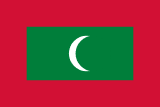
Maldives
Maldives
Population
529,676 (2025)
Average Monthly Net Salary (USD)
920
Average Mortgage Rate
10.50%
Annual GDP (USD)
7,741,066,861 (2025)
National Debt (USD)
9,180,000,000 (2025)
Unemployment Rate
4.51% (2025)
Armed Forces (active & reserve)
5,000
Military Expenditure (% GDP)
N/A
Fertility Rate
1.56 (2024)
Life Expectancy at birth
81.3 years (2024)
Population Growth
0.35% (2025)
Net Migration
-2,283 (2025)
Notable Facts
The Republic of Maldives is a quintessential archipelagic state located in the central Indian Ocean, south-southwest of India and Sri Lanka. It consists of a double chain of 26 natural atolls, which are composed of approximately 1,192 coral islands. These atolls are situated atop the Chagos-Laccadive Ridge, a vast submarine mountain range in the Indian Ocean. Geologically, the Maldives is unique as it is built entirely of coral reef structures that have grown around the submerged peaks of ancient volcanic mountains. The country is the lowest-lying nation in the world, with an average ground-level elevation of only 1.5 meters above sea level. This extreme topographical profile means that the nation lacks any significant inland hills or rivers, and its landmass is fragmented across roughly 90,000 square kilometers of ocean, creating a territory that is more than 99% water.
The early history of the Maldives is shrouded in mystery due to the lack of archaeological remains on the porous coral soil, but linguistic and cultural evidence suggests the islands were settled as early as the 4th century BCE by Indo-Aryan peoples from the Indian subcontinent, specifically from modern-day Gujarat and Sri Lanka. These early settlers brought with them Buddhism, which remained the dominant religion for over a millennium. This Buddhist era is evidenced by "havittas" - the ruins of ancient stupas - found on several southern atolls. The transition to Islam occurred in 1153 CE, according to local tradition, following the arrival of a North African or Arab traveler named Abu al-Barakat Yusuf al-Barbari. This conversion fundamentally reshaped Maldivian society, leading to the establishment of a sultanate that would rule the islands for the next eight centuries, creating a unique Islamic identity fused with maritime South Asian traditions.
The Maldivian political system was historically a sultanate, with power centered in the capital, Malé. Throughout the medieval and early modern periods, the Maldives maintained its independence despite the colonial expansion of European powers in the Indian Ocean. The Portuguese briefly occupied Malé in the mid-16th century but were expelled by local hero Muhammad Thakurufaanu Al Auzam, who is now celebrated as a national figure. In 1887, the Maldives became a British protectorate, though the British largely refrained from interfering in internal administrative affairs, focusing instead on defense and foreign relations. The sultanate was briefly abolished in 1953 in favor of a republic, only to be restored a year later. Full independence from Britain was achieved on July 26, 1965, and the country officially became a republic for the second and final time in 1968, ending the centuries-old monarchy.