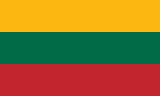
Lithuania
Lithuania
Population
2,888,774 (2025)
Average Monthly Net Salary (USD)
1,420
Average Mortgage Rate
3.95%
Annual GDP (USD)
95,210,150,818 (2025)
National Debt (USD)
32,840,000,000 (2025)
Unemployment Rate
6.73% (2025)
Armed Forces (active & reserve)
37,000
Military Expenditure (% GDP)
3.12% (2024)
Fertility Rate
1.11 (2024)
Life Expectancy at birth
77.2 years (2024)
Population Growth
0.02% (2025)
Net Migration
-24,618 (2025)
Notable Facts
The Republic of Lithuania, the largest and most populous of the three Baltic states, traces its sovereign roots to the 13th century when King Mindaugas unified various Baltic tribes to form the Kingdom of Lithuania in 1253. Following his reign, the state transitioned into the Grand Duchy of Lithuania, which expanded significantly through strategic marriages and military conquest. By the 15th century, under the leadership of Vytautas the Great, the Grand Duchy became the largest country in Europe, stretching from the Baltic Sea in the north to the Black Sea in the south. This era established Lithuania as a major medieval power, serving as a critical buffer between the Teutonic Knights to the west and the Mongol-Tartar forces to the east. The legacy of this period remains central to the national identity and historical consciousness of the modern republic.
In 1569, through the Union of Lublin, the Grand Duchy of Lithuania formally joined with the Kingdom of Poland to create the Polish-Lithuanian Commonwealth, a unique early modern dual state. While the two nations shared a monarch and a common parliament, the Grand Duchy maintained its own distinct laws, army, and treasury. This commonwealth was one of the most diverse and influential political entities in Europe for over two centuries, characterized by its "Golden Liberty" for the nobility. However, internal political decentralization and the rising power of neighboring empires led to its decline. Between 1772 and 1795, the commonwealth was partitioned in three stages by Russia, Prussia, and Austria, with the vast majority of Lithuanian territory falling under the rule of the Russian Empire for the next 123 years.
Lithuania regained its independence on February 16, 1918, during the closing stages of World War I, establishing a modern democratic republic with its provisional capital in Kaunas while Vilnius was under Polish control. This interwar period saw rapid cultural and economic development, but it was cut short by the events of World War II. Following the secret protocols of the Molotov-Ribbentrop Pact, the country was occupied first by the Soviet Union in 1940, then by Nazi Germany in 1941, and retaken by the Soviets in 1944. For nearly five decades, it existed as the Lithuanian Soviet Socialist Republic. On March 11, 1990, the Supreme Council of Lithuania declared the restoration of independence, making it the first Soviet republic to break away from the USSR, a move that precipitated the eventual dissolution of the Soviet Union.