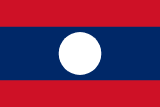
Laos
Laos
Population
7,873,046 (2025)
Average Monthly Net Salary (USD)
165
Average Mortgage Rate
12.00%
Annual GDP (USD)
18,302,970,219 (2025)
National Debt (USD)
13,820,000,000 (2024)
Unemployment Rate
1.19% (2025)
Armed Forces (active & reserve)
130,000
Military Expenditure (% GDP)
0.19% (2013)
Fertility Rate
2.40 (2024)
Life Expectancy at birth
69.2 years (2024)
Population Growth
1.32% (2025)
Net Migration
-10,645 (2025)
Notable Facts
The Lao People’s Democratic Republic, commonly known as Laos, is the only landlocked country in Southeast Asia, bordered by Myanmar, China, Vietnam, Cambodia, and Thailand. Historically known as Lan Xang, or the "Land of a Million Elephants," the region was a powerful unified kingdom from the 14th to the 18th century. Its geography is defined by thick forests and rugged mountains, particularly the Annamite Range which forms a natural border with Vietnam to the east. Phou Bia, the highest point in the country, reaches an elevation of 2,819 meters. This mountainous terrain has historically isolated many of the country's diverse ethnic groups, contributing to a rich but fragmented cultural landscape where traditional practices have remained largely intact despite centuries of regional conflict and colonial influence.
The political system of Laos is a one-party socialist republic governed by the Lao People’s Revolutionary Party (LPRP). Following the end of the monarchy in 1975, the LPRP established a centralized government based on Marxist-Leninist principles. The President serves as the Head of State, while the Prime Minister acts as the Head of Government, overseeing the Council of Ministers. The National Assembly is the unicameral legislative body, responsible for passing laws and approving the national socio-economic development plans. While the party maintains strict control over political life, the country began implementing economic reforms in the late 1980s under the "New Economic Mechanism," shifting from a centrally planned economy toward a more market-oriented model while retaining socialist political structures.
The Mekong River is the essential lifeblood of Laos, flowing approximately 1,900 kilometers through the country and forming a significant portion of the western border with Thailand. It serves as a primary transportation artery, a source of irrigation for agriculture, and a vital resource for the fishing industry. The river’s seasonal fluctuations dictate the agricultural calendar, particularly for wet-rice cultivation in the alluvial plains. In recent decades, the Lao government has embarked on an ambitious strategy to become the "Battery of Southeast Asia" by constructing numerous hydroelectric dams along the Mekong and its tributaries. These projects are designed to generate massive amounts of electricity for export to neighboring Thailand, Vietnam, and China, forming a cornerstone of the national export economy.