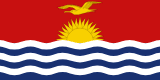
Kiribati
Kiribati
Population
136,488 (2025)
Average Monthly Net Salary (USD)
410
Average Mortgage Rate
8.50%
Annual GDP (USD)
349,227,254 (2025)
National Debt (USD)
40,000,000 (2024)
Unemployment Rate
N/A
Armed Forces (active & reserve)
0
Military Expenditure (% GDP)
N/A
Fertility Rate
3.12 (2024)
Life Expectancy at birth
66.6 years (2024)
Population Growth
1.45% (2025)
Net Migration
-462 (2025)
Notable Facts
Kiribati is a sovereign state in Micronesia, consisting of 33 coral atolls and one raised coral island, Banaba. The nation is uniquely positioned as the only country in the world to be situated in all four hemispheres, straddling both the equator and the 180th meridian. These islands are divided into three main groups: the Gilbert Islands, the Phoenix Islands, and the Line Islands. Despite having a relatively small land area, the country’s territory is scattered across approximately 3.5 million square kilometers of the central Pacific Ocean. This vast maritime domain gives Kiribati one of the largest Exclusive Economic Zones in the world, which is a critical asset for its national economy and regional geopolitical standing.
The topography of Kiribati is characterized by low-lying atolls that rarely rise more than a few meters above sea level. These ring-shaped coral reefs enclose central lagoons, providing essential habitats for marine life and a source of subsistence for the local population. The soil on these atolls is thin, calcareous, and highly porous, with limited water-holding capacity and low nutrient content. Consequently, natural vegetation is restricted mainly to salt-tolerant species such as coconut palms, pandanus, and breadfruit trees. Banaba, the only non-atoll island, was once a significant source of high-grade phosphate, but decades of intensive mining prior to independence in 1979 have left its landscape largely decimated and its primary resource exhausted.
The political history of Kiribati is marked by its transition from a British protectorate and colony to an independent republic. The Gilbert and Ellice Islands were established as a British protectorate in 1892 and became a Crown Colony in 1916. Following a referendum in 1974 based on ethnic and linguistic differences, the Ellice Islands separated to become Tuvalu, while the Gilbert Islands moved toward sovereignty. On July 12, 1979, the nation achieved full independence as the Republic of Kiribati. The government is a parliamentary republic, where the President, known as the Beretitenti, serves as both the head of state and the head of government, elected by popular vote from among members of the Maneaba ni Maungatabu (House of Assembly).