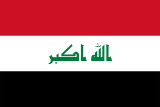
Iraq
Iraq
Population
47,020,774 (2025)
Average Monthly Net Salary (USD)
515
Average Mortgage Rate
9.00%
Annual GDP (USD)
254,367,293,538 (2025)
National Debt (USD)
108,300,000,000 (2024)
Unemployment Rate
15.48% (2025)
Armed Forces (active & reserve)
193,000
Military Expenditure (% GDP)
2.36% (2024)
Fertility Rate
3.22 (2024)
Life Expectancy at birth
72.4 years (2024)
Population Growth
2.10% (2025)
Net Migration
-1,064 (2025)
Notable Facts
The Republic of Iraq is a federal parliamentary republic located in Western Asia, bordered by Turkey to the north, Iran to the east, Kuwait and Saudi Arabia to the south, and Jordan and Syria to the west. Under the 2005 Constitution, the political system is divided into executive, legislative, and judicial branches. The President of Iraq serves as the head of state and a symbol of national unity, elected by a two-thirds majority of the Council of Representatives for a four-year term. The Prime Minister is the head of government and the active executive authority, nominated by the largest parliamentary bloc. The legislative body, the Council of Representatives (Majlis an-Nuwwab), consists of 329 seats. Administratively, Iraq is divided into 18 governorates, with the semi-autonomous Kurdistan Region in the north maintaining its own regional government and parliament.
The demographics of Iraq reflect a multiethnic and multi-religious society. Arabs constitute the largest ethnic group, making up roughly 75–80% of the population, followed by Kurds at 15–20%. Other significant minorities include Turkmen, Assyrians, Yazidis, Shabaks, and Mandaeans. Arabic and Kurdish are the two official languages, while Turkmen and Syriac are recognized as official languages in administrative units where they constitute a population density. Islam is the official state religion and the foundation of legislation; approximately 95–98% of Iraqis are Muslim, split between Shia and Sunni denominations. Small but historically vital communities of Christians and other faiths persist, primarily in the northern Nineveh Plains and urban centers like Baghdad.
Iraq’s geography is defined by the alluvial plains of the Tigris and Euphrates rivers, which flow from the highlands of Turkey through the center of the country to the Shatt al-Arab waterway. This fertile region, historically known as Mesopotamia, contrasts sharply with the Syrian Desert to the west and the rugged Zagros Mountains to the northeast. In the south, the Mesopotamian Marshes represent a unique wetland ecosystem and a UNESCO World Heritage site. The climate is predominantly hot and arid, with summer temperatures regularly exceeding 45°C, while the northern mountainous regions experience cooler Mediterranean climates with winter snowfall. Iraq possesses a narrow coastline of approximately 58 km (36 miles) along the Persian Gulf, where its primary deep-water port, Umm Qasr, is located.