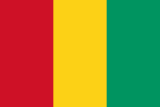
Guinea
Guinea
Population
15,099,727 (2025)
Average Monthly Net Salary (USD)
380
Average Mortgage Rate
18.00%
Annual GDP (USD)
28,346,024,753 (2025)
National Debt (USD)
7,840,000,000 (2024)
Unemployment Rate
5.16% (2025)
Armed Forces (active & reserve)
12,600
Military Expenditure (% GDP)
2.05% (2024)
Fertility Rate
4.13 (2024)
Life Expectancy at birth
60.9 years (2024)
Population Growth
2.31% (2025)
Net Migration
-16,282 (2025)
Notable Facts
The Republic of Guinea is a sovereign state located on the western coast of Africa, bordered by the Atlantic Ocean to the west, Guinea-Bissau to the northwest, Senegal to the north, Mali to the northeast, Côte d'Ivoire to the east, and Sierra Leone and Liberia to the south. The country is characterized by a diverse landscape that includes coastal plains, the mountainous Fouta Djallon highlands, and dense tropical rainforests in the southeast. Known as the "water tower of West Africa," Guinea is the source of several major regional rivers, including the Niger, Senegal, and Gambia. Its strategic maritime position and abundant natural resources make it a critical node for regional trade and an essential player in the economic development of the Mano River Union and the broader West African region.
Guinean political administration transitioned through a significant period of military-led governance following a coup in 2021. As of early 2026, the country operates under a new constitutional framework approved via referendum in late 2025. This 2025 Constitution established a unitary republic with a presidential system, where the President serves as head of state for a seven-year term, renewable once. General Mamadi Doumbouya was inaugurated as the first president under this new order in January 2026. The legislative branch is now bicameral, consisting of a National Assembly and a Senate, replacing the previous unicameral structure. In March 2026, the government took steps to consolidate the political landscape by dissolving 40 political parties, signaling a move toward a more centralized "party-state" model aimed at maintaining national stability during the post-transition period.
Economically, Guinea is a resource-rich nation. This growth is primarily driven by a massive expansion in the mining sector, specifically the commencement of exports from the Simandou iron ore project. While the country is the world's leading exporter of bauxite, the Simandou project represents one of the largest untapped high-grade iron ore deposits globally. The economy is currently in the midst of a second "mining boom," with the sector accounting for over 75% of total export earnings. Despite this industrial strength, the country remains a low-income economy with significant wealth inequality; the government is focused on utilizing mining revenues to fund infrastructure projects and reduce a poverty rate that affected over 50% of the population as of 2025.