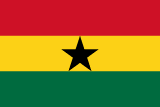
Ghana
Ghana
Population
35,064,272 (2025)
Average Monthly Net Salary (USD)
210
Average Mortgage Rate
31.00%
Annual GDP (USD)
114,209,905,279 (2025)
National Debt (USD)
52,430,000,000 (2024)
Unemployment Rate
2.98% (2025)
Armed Forces (active & reserve)
15,500
Military Expenditure (% GDP)
0.38% (2024)
Fertility Rate
3.34 (2024)
Life Expectancy at birth
65.7 years (2024)
Population Growth
1.83% (2025)
Net Migration
-17,079 (2025)
Notable Facts
The Republic of Ghana is a sovereign unitary state located along the Gulf of Guinea and the Atlantic Ocean in the West African subregion. It shares land borders with Côte d'Ivoire to the west, Burkina Faso to the north, and Togo to the east. The country’s geography is diverse, characterized by a coastal belt of low-lying plains, the Ashanti uplands, and the expansive Volta Basin in the central and northern regions. A defining feature of its landscape is Lake Volta, the world’s largest artificial reservoir by surface area, created by the Akosombo Dam. Historically, Ghana’s location made it a central hub for trans-Saharan trade and later maritime commerce, a strategic position it maintains today through its major deep-water ports and growing role in regional West African integration.
Administratively, Ghana is divided into 16 regions, a structure expanded in 2019 from the original ten to improve decentralized governance and service delivery. These regions include Greater Accra, Ashanti, Western, Eastern, Central, Volta, Northern, Upper East, Upper West, Bono, Bono East, Ahafo, Savannah, North East, Oti, and Western North. Each region is further subdivided into 261 metropolitan, municipal, or district assemblies, which serve as the primary units of local government. The capital city, Accra, is the political, economic, and administrative center of the nation, while Kumasi serves as a major commercial and cultural hub in the central forest belt. Regional ministers appointed by the President oversee the administration of these territories, ensuring that central government policies are implemented at the local level.
The legal system of Ghana is a hybrid framework based on English Common Law, statutory law, and customary law, as established under the 1992 Constitution. The judiciary is independent and hierarchical, consisting of the Superior Courts of Judicature - comprising the Supreme Court, the Court of Appeal, and the High Court - and Lower Courts, which include Circuit Courts and District Courts. Customary law, which relates to the particular traditions and values of various indigenous communities, is formally recognized and integrated into the legal system, particularly regarding land tenure and chieftaincy disputes. The Supreme Court of Ghana is the final arbiter of constitutional interpretation and holds the authority to strike down laws that conflict with the supreme law of the land.