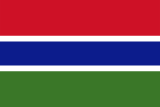
Gambia
Gambia
Population
2,822,093 (2025)
Average Monthly Net Salary (USD)
125
Average Mortgage Rate
16.00%
Annual GDP (USD)
2,593,673,988 (2025)
National Debt (USD)
1,620,000,000 (2024)
Unemployment Rate
6.52% (2025)
Armed Forces (active & reserve)
4,000
Military Expenditure (% GDP)
0.57% (2024)
Fertility Rate
3.91 (2024)
Life Expectancy at birth
66.1 years (2024)
Population Growth
2.23% (2025)
Net Migration
-2,984 (2025)
Notable Facts
The Republic of The Gambia is a sovereign state in West Africa, almost entirely surrounded by Senegal except for a short coastline on the Atlantic Ocean. Its unusual shape, extending inland along the banks of the Gambia River, is a direct result of 19th-century Anglo-French colonial competition, where the British secured control over the navigable portion of the river while the French occupied the surrounding territory. The nation’s geography is dominated by the river, which flows through the center of the country and provides a critical artery for transport, irrigation, and fishing. The topography is generally flat, with the highest elevations rarely exceeding 50 meters above sea level, consisting primarily of a plateau divided by the river’s floodplains and mangrove swamps.
The administrative structure of The Gambia is divided into five regions and two municipalities, which are further subdivided into 43 districts. These regions include the West Coast, Lower River, Central River, Upper River, and North Bank, while the urban centers of Banjul and Kanifing function as distinct municipal entities. Local governance is managed through a combination of central government appointments and local councils, reflecting a system that has evolved since the country transitioned from a British colony to an independent republic in 1965. The capital, Banjul, is situated on St. Mary's Island at the mouth of the Gambia River, serving as the country's primary port and administrative hub, though the neighboring Kanifing Municipality is more populous and serves as a major commercial center.
The Gambian legal system is characterized by a tripartite structure that integrates English Common Law, Islamic Sharia Law, and Customary Law. English Law, inherited from the colonial era, applies to most civil and criminal matters and is administered through the Supreme Court, Court of Appeal, and High Court. Sharia Law is specifically applied to matters of marriage, divorce, and inheritance among the Muslim majority, overseen by Cadi Courts. Customary Law, administered by District Tribunals, governs traditional land tenure and communal disputes within specific ethnic communities. This pluralistic legal framework ensures that the state can manage diverse social norms while maintaining a unified national judiciary under the 1997 Constitution, which remains the supreme law of the land.