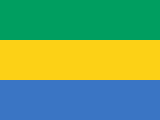
Gabon
Gabon
Population
2,593,130 (2025)
Average Monthly Net Salary (USD)
455
Average Mortgage Rate
9.50%
Annual GDP (USD)
21,427,119,323 (2025)
National Debt (USD)
11,240,000,000 (2024)
Unemployment Rate
20.15% (2025)
Armed Forces (active & reserve)
8,100
Military Expenditure (% GDP)
1.54% (2024)
Fertility Rate
3.59 (2024)
Life Expectancy at birth
68.5 years (2024)
Population Growth
2.11% (2025)
Net Migration
1,116 (2025)
Notable Facts
Gabon is a sovereign nation located on the Atlantic coast of Central Africa, characterized by its equatorial positioning on the Earth's surface. The country shares land borders with Equatorial Guinea to the northwest, Cameroon to the north, and the Republic of the Congo to the east and south. Geographically, it is divided into three distinct regions: a narrow coastal plain, a hilly interior dominated by the Crystal Mountains and the Chaillu Massif, and a plateau region in the east and south. The Ogooué River serves as the primary hydrological artery, flowing approximately 1,200 km through the territory and draining a massive basin that covers nearly the entire nation. Its capital and largest city, Libreville, is situated on the Komo River estuary, serving as the administrative and commercial hub.
The administrative structure of the Gabonese Republic is organized into nine distinct provinces, which are further subdivided into departments and prefectures to facilitate local governance. These provinces include Estuaire, Haut-Ogooué, Moyen-Ogooué, Ngounié, Nyanga, Ogooué-Ivindo, Ogooué-Lolo, Ogooué-Maritime, and Woleu-Ntem. Each province is headed by a governor appointed by the central executive power. This hierarchical system ensures that the central government in Libreville maintains administrative oversight over the remote and heavily forested interior regions. The legal system is based on French civil law and customary law, with the judiciary consisting of the Constitutional Court, the Judicial Council, and the Supreme Court. The political framework operates as a presidential republic, where the head of state holds significant executive authority.
The national economy is heavily reliant on the extraction and export of hydrocarbons, which traditionally account for a substantial portion of the Gross Domestic Product and government revenue. Gabon is one of the top five oil producers in Sub-Saharan Africa, with the majority of its crude oil reserves located in offshore fields. The sector is managed through the Gabon Oil Company and various international energy firms. While oil has provided the country with one of the highest per capita incomes in the region, the volatility of global market prices often impacts the national budget. To mitigate this dependence, the government has historically sought to diversify the industrial base through the "Emerging Gabon" strategic plan, focusing on value-added processing in other natural resource sectors.