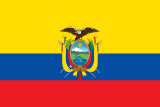
Ecuador
Ecuador
Population
18,289,896 (2025)
Average Monthly Net Salary (USD)
512.65
Average Mortgage Rate
9.85%
Annual GDP (USD)
130,320,560,400 (2025)
National Debt (USD)
87,469,000,000 (2025)
Unemployment Rate
3.31% (2025)
Armed Forces (active & reserve)
177,100
Military Expenditure (% GDP)
2.22% (2024)
Fertility Rate
1.81 (2024)
Life Expectancy at birth
77.6 years (2024)
Population Growth
0.85% (2025)
Net Migration
-17,219 (2025)
Notable Facts
The geographical identity of Ecuador is anchored by the Andes Mountains, which split the mainland into three distinct continental regions: the Costa (Pacific lowlands), the Sierra (Andean highlands), and the Oriente (Amazon basin). This mountainous "spine" consists of two parallel cordilleras - the Western and the Eastern - separated by a high-altitude central valley. This arrangement creates a series of isolated basins where the majority of the highland population resides. The extreme variation in altitude across these regions allows for a staggering range of ecosystems to exist within a relatively small landmass, from tropical mangroves at sea level to glacial barrens above 5,000 meters.
Mount Chimborazo, an inactive stratovolcano in the Cordillera Occidental, holds a unique distinction in global geodesy. Although Mount Everest is the highest peak above sea level, Chimborazo’s summit is actually the point on Earth’s surface closest to the stars. This occurs because the Earth is not a perfect sphere but an oblate spheroid that bulges at the equator. Located just one degree south of the equator, Chimborazo sits on this bulge, placing its peak approximately 2,100 meters further from the Earth’s center than the summit of Everest. This physical reality makes the Ecuadorian highlands a primary site for astronomical and geodetic measurements.
The volcanic density of Ecuador is among the highest in the world, with over 80 volcanic formations identified on the mainland alone. The explorer Alexander von Humboldt famously named the central Andean valley the "Avenue of Volcanoes" due to the high concentration of massive, snow-capped peaks visible from the trail. Many of these, such as Cotopaxi, Sangay, and Reventador, remain highly active. Cotopaxi is particularly notable for its nearly perfect conical shape and its history of violent eruptions that have periodically reshaped the surrounding landscape with lahars - massive mudflows triggered by the melting of its summit glaciers.