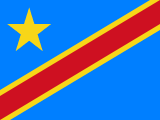
Democratic Republic of the Congo
Democratic Republic of the Congo
Population
112,832,473 (2025)
Average Monthly Net Salary (USD)
140
Average Mortgage Rate
20.00%
Annual GDP (USD)
91,030,531,317 (2025)
National Debt (USD)
10,210,000,000 (2024)
Unemployment Rate
4.43% (2025)
Armed Forces (active & reserve)
134,250
Military Expenditure (% GDP)
1.23% (2024)
Fertility Rate
5.98 (2024)
Life Expectancy at birth
62.1 years (2024)
Population Growth
3.20% (2025)
Net Migration
-27,309 (2025)
Notable Facts
The Democratic Republic of the Congo (DRC) is located in Central Africa and holds the distinction of being the second-largest country on the continent by land area. Covering approximately 2.34 million square kilometers, it is a vast nation characterized by its immense biological and geographical diversity. The country shares its borders with nine other nations: the Republic of the Congo, the Central African Republic, South Sudan, Uganda, Rwanda, Burundi, Tanzania, Zambia, and Angola. Despite its significant size and central positioning, the DRC maintains only a very small, 37-kilometer-long coastline along the South Atlantic Ocean, which acts as the primary exit point for its massive river system.
The Congo River, the world’s deepest river and the second-longest in Africa, serves as the lifeblood of the nation. Spanning over 4,700 kilometers, it is a massive waterway that drains the vast Congo Basin, which is the world's second-largest tropical rainforest after the Amazon. This basin covers about 60% of the country’s territory and is essential to the global climate, acting as a critical carbon sink. The river system provides an extensive network of navigable waterways that have historically been the primary mode of transport for goods and people in areas where road infrastructure is limited or nonexistent.
The Congo Basin, often referred to as the "second lung" of the planet, is an ecological powerhouse of immense global significance. Spanning across the Democratic Republic of the Congo and several neighboring nations, this vast tropical rainforest plays a critical role in sequestering carbon dioxide from the atmosphere, thereby helping to regulate global temperatures. The density of the biomass within this region is extraordinary, housing an unparalleled concentration of tree species and complex undergrowth that acts as a massive carbon storehouse. Protecting this environment is essential for maintaining atmospheric stability, as any large-scale disruption to the basin’s integrity would release significant amounts of stored carbon into the ecosystem.