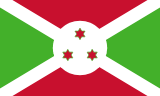
Burundi
Burundi
Population
14,390,003 (2025)
Average Monthly Net Salary (USD)
227
Average Mortgage Rate
15.60%
Annual GDP (USD)
3,364,713,864 (2025)
National Debt (USD)
2,890,000,000 (2024)
Unemployment Rate
0.92% (2025)
Armed Forces (active & reserve)
30,050
Military Expenditure (% GDP)
3.80% (2024)
Fertility Rate
4.79 (2024)
Life Expectancy at birth
63.8 years (2024)
Population Growth
2.41% (2025)
Net Migration
-34,727 (2025)
Notable Facts
Burundi, a small landlocked nation in the Great Lakes region of East Africa, is often referred to as the "Heart of Africa" due to its shape and central location on the continent. It is one of the few nations in Africa whose modern borders largely coincide with those of a pre-colonial kingdom. Historically, the Kingdom of Burundi was a centralized and powerful monarchy that existed for centuries before the arrival of European explorers. Unlike many other African states that were artificial colonial constructs, Burundi’s national identity is deeply rooted in this ancient monarchical tradition, which was led by a Mwami (King). This historical continuity has played a significant role in the development of its social hierarchy and political culture.
The geography of Burundi is defined by its mountainous terrain, with the country sitting on the rolling plateau that divides the Nile and Congo River basins. This unique positioning makes Burundi home to the southernmost source of the Nile River, located in the Rutovu commune. The landscape is characterized by "a thousand hills," featuring lush greenery, steep slopes, and fertile volcanic soil that supports one of the highest population densities in sub-Saharan Africa. The western border of the country is dominated by the dramatic Rift Valley and the shores of Lake Tanganyika, the world's longest freshwater lake and the second deepest, providing the nation with vital fishing resources and a maritime link to its neighbors.
Lake Tanganyika is a cornerstone of Burundian life and ecology, hosting hundreds of species of cichlid fish found nowhere else on Earth. The lake serves as a critical transport artery, connecting the economic capital, Bujumbura, to Tanzania, Zambia, and the Democratic Republic of the Congo. Because Burundi is landlocked, the Port of Bujumbura acts as a primary gateway for international trade, despite the logistical challenges of navigating the vast lake. The shoreline is also home to diverse wildlife, including hippopotamuses and crocodiles, and provides a unique microclimate that supports the cultivation of palm oil and other tropical crops along the narrow coastal plain.