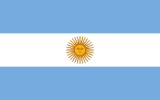
Argentina
Argentina
Population
45,851,378 (2025)
Average Monthly Net Salary (USD)
465
Average Mortgage Rate
53.12%
Annual GDP (USD)
683,097,891,619 (2025)
National Debt (USD)
454,037,100,000 (2025)
Unemployment Rate
7.14% (2025)
Armed Forces (active & reserve)
102,550
Military Expenditure (% GDP)
0.62% (2024)
Fertility Rate
1.50 (2024)
Life Expectancy at birth
77.5 years (2024)
Population Growth
0.34% (2025)
Net Migration
2,859 (2025)
Notable Facts
Argentina is a federal republic located in the southern cone of South America, bordered by the Andes Mountains to the west and the Atlantic Ocean to the east. It is the eighth-largest country in the world by land area and the second-largest in South America after Brazil. Its territory encompasses a diverse range of landscapes, including the tropical rainforests of the north, the fertile central plains known as the Pampas, and the arid, windswept plateaus of Patagonia in the south. The country also claims a portion of Antarctica and several islands in the South Atlantic. This vast latitudinal stretch results in a highly varied geography that supports a wide array of economic activities and biological ecosystems, ranging from the high-altitude deserts of the Puna to the glacial fjords of Tierra del Fuego.
The political system of Argentina is a federal presidential representative democratic republic, where the President serves as both head of state and head of government. The country is divided into 23 provinces and the autonomous city of Buenos Aires, each of which retains all powers not explicitly delegated to the federal government, including the administration of justice and primary education. The legislative branch consists of a bicameral National Congress, comprising a Senate representing the provinces and a Chamber of Deputies representing the people. The legal system is based on civil law, primarily influenced by Roman, French, and Spanish traditions, with a Supreme Court of Justice at the apex of the judicial hierarchy. The 1994 constitutional reform further decentralized power and introduced new rights and guarantees for citizens.
The Argentine economy is characterized by its massive agricultural sector, which makes the country one of the world’s leading producers of food products. The Pampas, a vast area of fertile soil in the central region, is the heart of the nation’s grain and livestock production. Argentina is a top global exporter of soy and its derivatives, as well as maize, wheat, and beef. The agricultural industry is highly technologically advanced, utilizing satellite imaging and precision farming to maximize yields. Beyond the Pampas, the country produces significant quantities of grapes for wine in the Cuyo region, citrus fruits in the northwest, and apples and pears in the Rio Negro valley. Agricultural exports are the primary source of foreign currency for the national treasury.